

You've probably heard that tarot can predict your financial future. Maybe you've imagined a reader telling you exactly when a raise is coming or how much money you'll have next year. That's a common misconception, and it's worth clearing up right away. Understanding what is a financial tarot reading actually means can change how you use this tool entirely. Financial tarot readings are not about fixed outcomes. They're about symbolic guidance, mindset clarity, and helping you see your money path more honestly. This guide will show you exactly how they work and how to use them well.
Table of Contents
- Understanding financial tarot readings: purpose and process
- Common financial tarot spreads and their interpretations
- Tarot's role in promoting financial mindset and skill development
- Risks and ethical considerations in financial tarot readings
- Practical steps for integrating financial tarot readings into your money decisions
- A fresh perspective on financial tarot readings: beyond prediction to empowerment
- Explore personalized tarot guidance with Astrea Tarot
- Frequently asked questions
Key Takeaways
| Point | Details |
|---|---|
| Symbolic guidance | Financial tarot readings provide symbolic insights into your money path rather than fixed predictions. |
| Mindset focus | Tarot emphasizes long-term financial mindset and skill development over quick fixes. |
| Ethical use | Responsible tarot use treats readings as reflections, not replacements for professional advice. |
| Actionable insights | Effective tarot readings map cards to real financial decisions and behaviors you can change. |
| Empowerment tool | Financial tarot works best as a tool to empower self-awareness and practical money growth. |
Understanding financial tarot readings: purpose and process
Financial tarot readings use card spreads to give you insight into your money situation. They don't hand you a forecast with exact numbers or dates. Instead, they reflect your current financial energy, highlight areas of opportunity, and point to pressures you may be overlooking.
One of the most well-known examples is the Financial Future Tarot. This is a 5-card spread that reveals near-to-medium-term money trajectories without promises or timing. Each card in the spread addresses a specific area of your financial life.
Here's what a typical Financial Future Tarot spread covers:
- Current trajectory: Where your finances are heading right now
- Upcoming opportunities: What possibilities may be opening up for you
- Pressures or challenges: What's working against your financial growth
- Strengthening actions: What you can do to improve your situation
- Projected trends: The likely direction if you stay on your current path
You can explore different tarot reading methods to find the approach that resonates most with your financial questions.
Tarot is a symbolic tool. It sparks reflection. It doesn't make decisions for you, and it doesn't replace careful financial planning. When you approach it this way, it becomes genuinely useful.
Common financial tarot spreads and their interpretations
Now that you understand the foundation, let's look at how popular spreads work in practice and what their card meanings actually point to.
The Financial Future Tarot spread is structured to address near-to-medium-term directions. As noted, it does not guarantee money or timing. That clarity is important before you sit down with any spread.
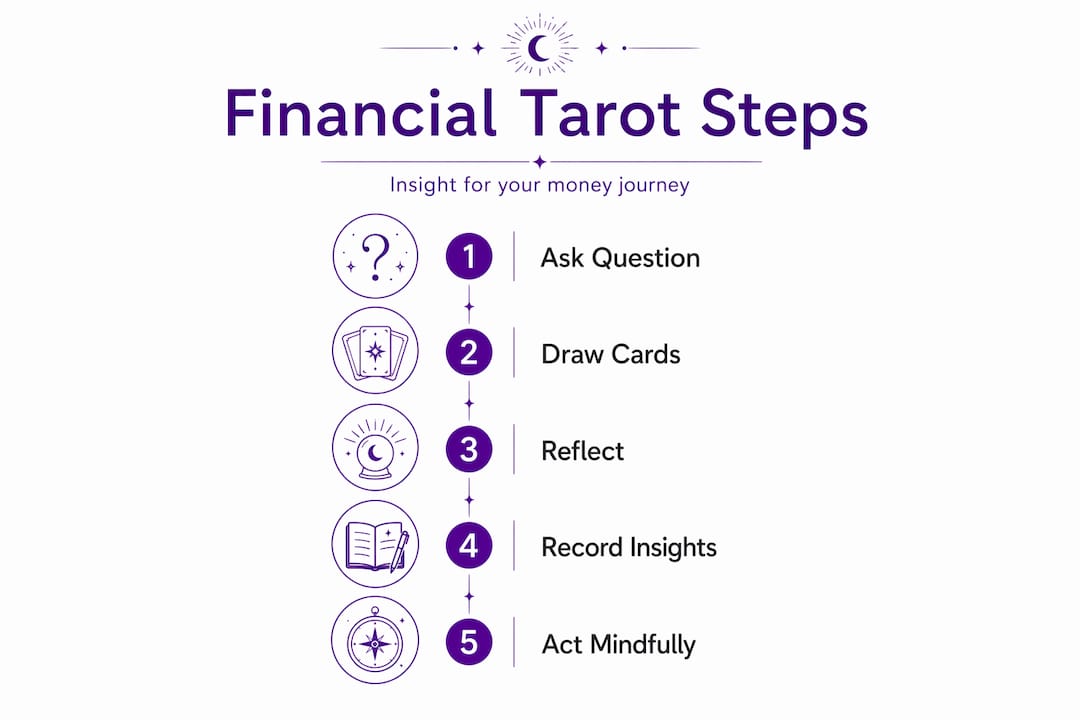
Here's a step-by-step look at how to interpret a financial tarot spread:
- Set a clear intention. Before drawing cards, name the specific financial situation you want insight on. Vague questions get vague answers.
- Draw your cards in order. Each position in the spread has a role. Don't shuffle the meanings.
- Read each card in context. A card that signals caution in one position may signal opportunity in another.
- Look for patterns. Multiple cards from the same suit often signal a theme. Pentacles, for example, are heavily connected to material and financial matters.
- Translate symbols into actions. Ask yourself: what behavior or mindset shift does this card suggest?
Pro Tip: Keep a simple tarot journal. Write down the cards you drew, your initial reaction, and what financial decision you were facing. Review it monthly. You'll start to see patterns in how your financial mindset shows up.
Here's a quick reference for common card themes in money readings:
| Card | Financial theme | Practical message |
|---|---|---|
| Ace of Pentacles | New financial opportunity | Look for fresh income sources |
| Five of Pentacles | Financial hardship | Seek support, reassess spending |
| The Empress | Abundance and growth | Nurture long-term financial plans |
| The Tower | Sudden disruption | Prepare an emergency fund |
| Eight of Pentacles | Skill-building | Invest in your professional growth |
You can also explore using tarot spreads for other life areas to see how the same cards shift meaning depending on context.
The key takeaway here is that tarot card readings for money work best when you treat each card as a conversation starter, not a conclusion.
Tarot's role in promoting financial mindset and skill development
This is where financial tarot insights get genuinely interesting. Most people expect tarot to tell them what will happen. What it actually does is show you what's happening inside your approach to money.

Tarot money insight points toward behavioral and skill-based changes rather than magic or immediate fixes. That's a significant distinction. It means the cards are reflecting your patterns back to you.
Here's what tarot commonly highlights in financial readings:
- Patience over urgency. Many financial tarot messages encourage you to build steadily rather than chase fast results.
- Skill gaps. Cards may point to areas where developing new knowledge or abilities could shift your financial situation.
- Mindset alignment. Are your beliefs about money holding you back? Tarot often surfaces this before you consciously recognize it.
- Balance between expansion and stability. Growing too fast without a foundation is a common theme that shows up in readings.
Pro Tip: When a card's message feels uncomfortable, sit with it. Discomfort in a reading often signals exactly the area where your financial growth is stuck.
Tarot serves best as a mirror. It reflects your current decisions and mindset back to you. That reflection, when taken seriously, gives you insight to grow financially over time. This is the real benefit of financial tarot. It's not about what the universe will hand you. It's about understanding financial tarot as a tool for self-awareness.
You can explore this reflective tarot purpose further to see how the same principles apply across different life areas.
Risks and ethical considerations in financial tarot readings
Tarot can be genuinely helpful. It can also be misused. Knowing the difference protects you.
Tarot readings become harmful when they increase anxiety, create dependency, or encourage fear-based financial decisions. That's a real risk, and it's worth taking seriously.
Watch for these red flags in any financial tarot reading:
- Guaranteed outcomes. No ethical reader promises specific financial results.
- Fear-based messaging. If a reading makes you feel panicked or desperate, that's a problem.
- Escalating fees. Some readers use alarming card interpretations to push you toward expensive follow-up sessions.
- Dependency patterns. If you feel you can't make any financial decision without a reading, that's a sign to step back.
- Pressure to act fast. Urgency tactics in tarot readings are a warning sign, not a spiritual message.
"Tarot is safest when used as a reflection tool, not as a substitute for professional advice, evidence-based decision-making, or real-world judgment." This framing keeps you in control of your own financial life.
Responsible tarot use means treating readings as supportive and reflective, not authoritative. You always have agency. The cards don't decide anything. You do. For more on ethical tarot guidance, it helps to understand the values behind responsible reading practices.
Practical steps for integrating financial tarot readings into your money decisions
Understanding financial tarot is one thing. Using it well in real life is another. Here's how to make it a genuinely useful part of your financial routine.
- Ask concrete questions. Instead of "Will I be rich?" try "What mindset is blocking my savings growth right now?" Specific questions get specific insights.
- Map the insight to a real decision. The most useful tarot questions map to real decision points, prompting actionable mindset or behavior changes you can act on immediately.
- Identify one behavior to shift. After a reading, choose one concrete action. Maybe it's reviewing your budget, or finally booking that meeting with a financial advisor.
- Combine tarot with practical tools. Use readings alongside budgeting apps, professional financial advice, and ongoing money education.
- Review your readings over time. Patterns in your readings often reveal persistent mindset blocks that need attention.
Pro Tip: Schedule a monthly financial tarot check-in alongside your budget review. Treat them as complementary practices. One gives you numbers. The other gives you perspective on how you feel about those numbers.
Tarot works best as one layer of your financial wellness routine, not the whole thing. It's a source of clarity and motivation. Pair it with practical tarot guidance and real-world financial planning for the best results.
A fresh perspective on financial tarot readings: beyond prediction to empowerment
Here's something most articles about financial tarot won't tell you: the people who get the most out of these readings are not the ones hoping for good news. They're the ones willing to look honestly at their financial habits and beliefs.
The popular image of tarot as a prediction machine actually undermines its real value. When you sit down expecting a forecast, you're handing your agency over to the cards. When you sit down expecting a mirror, you get something far more useful: a clear look at where you are and what you're avoiding.
Financial tarot's real power is in guiding self-awareness and long-term mindset alignment. Not fortune telling. The most impactful readings happen when you bring a real question and genuine openness. Not "what will happen?" but "what am I missing?"
Empowerment through tarot means using the insights you receive to consciously choose better habits. It means seeing a card that signals financial pressure and asking yourself, honestly, whether that pressure is already present in your life. It means letting a card about skill-building push you to finally take that course or learn that financial skill you've been putting off.
This is what understanding financial tarot really looks like in practice. It's not passive. It's active. You take the symbolic message and turn it into a decision. That's where the growth happens.
The empowerment through tarot approach positions you as the author of your financial story. The cards are just a prompt. You write what happens next.
Explore personalized tarot guidance with Astrea Tarot
If you're ready to experience the benefits of financial tarot for yourself, Astrea Tarot is here to support you.

Astrea Tarot offers personalized readings that blend spiritual insight with responsible, reflective guidance. Our approach prioritizes your empowerment, not dependency. You can explore our reading methods to understand how we combine intuitive card selection with structured analysis for real clarity. If you want to start without commitment, try our free tarot readings and see what insights surface for your financial and personal journey. Every reading is designed to support your decisions, not replace them.
Frequently asked questions
What exactly is a financial tarot reading?
A financial tarot reading uses tarot cards to provide symbolic insights about your money path, focusing on guidance and mindset rather than exact predictions or timing. It is a 5-card spread revealing near-to-medium-term money trajectories without promises or timing.
Can tarot readings tell me the exact amount of money I will get?
No, tarot readings do not predict fixed money amounts. As clearly stated in responsible reading practices, it is not a promise of a fixed amount of money or a timing spread.
Is it safe to rely on tarot readings for important financial decisions?
Tarot should be used as a reflective tool, not a substitute for professional financial advice. Tarot is safest when used as a reflection tool, not as a substitute for professional advice or evidence-based decision-making.
How can I get the most benefit from a financial tarot reading?
Ask questions tied to real financial decisions and use the insights to guide mindset or behavior changes. The most useful questions map to real decision points and lead to behavior or mindset changes you can act on immediately.
Which tarot cards are considered lucky for manifesting money?
Cards like the 10 of Pentacles, 9 of Pentacles, The Empress, and The Sun are often seen as symbols of wealth and abundance. These four cards are particularly powerful for attracting wealth and success in money readings.