

You feel stuck. You know something needs to change, but you can't name it. That's exactly where tarot reading for self-discovery becomes useful. Not as a crystal ball, but as a structured way to ask better questions about your own life. As Vogue puts it, "Tarot cards are a tool for personal discovery and self-care." This guide walks you through exactly how to use tarot for emotional insight, honest self-reflection, and real, actionable clarity.
Table of Contents
- Understanding tarot as a tool for self-discovery
- Setting up your space and mind for a powerful self-reading
- Executing your tarot reading: from shuffling to interpretation
- Troubleshooting, common mistakes, and integrating tarot insights
- Why tarot is a vital tool for embracing uncertainty and personal agency
- Explore professional tarot readings and tools for deeper self-discovery
- Frequently asked questions
Key Takeaways
| Point | Details |
|---|---|
| Tarot as coaching tool | Tarot is a reflective tool that supports self-discovery and personal coaching, not fortune-telling. |
| Preparation matters | Creating a calm space and clear intentions significantly enhances the quality of your tarot reading. |
| Intuition leads | Trusting your intuitive response to tarot imagery is more important than memorizing card meanings. |
| Embrace ambiguity | Tarot works best by holding space for uncertainty, helping you uncover your own truths. |
| Integration vital | Journaling and applying insights deepen your growth and psychological well-being over time. |
Understanding tarot as a tool for self-discovery
Most people think tarot is about predicting the future. It isn't. Modern tarot is closer to coaching than fortune-telling. It helps you look at your past, examine your present, and consider possible futures without locking you into any one outcome.
Think of the cards as mirrors. Each image reflects something back at you. That reflection might be a feeling you've been avoiding, a pattern you keep repeating, or a truth you already know but haven't said out loud yet.
This is why tarot works so well as a tarot reading method for personal growth. The 78 cards in a standard deck are built around archetypes, universal human experiences like love, loss, ambition, fear, and transformation. When you pull a card, your mind connects those archetypes to your own life. That connection is where the insight lives.
As one source explains, tarot functions as a projective tool where "your subconscious projects meaning onto it, revealing beliefs and patterns you can't consciously access through conversation alone." That's not mysticism. That's psychology.
Here's what tarot actually does for you in a self-discovery context:
- Surfaces hidden feelings you haven't been able to name
- Breaks decision paralysis by giving you a structured prompt to react to
- Reveals emotional patterns you repeat across relationships or situations
- Encourages honest self-talk without the judgment of another person
- Supports your self-love journey by making space for your inner voice
"Tarot is not fortune-telling, it's coaching... It's a glimpse into the energetic landscape that supports making the best decisions for yourself moving forward." — Vogue
This shift in perspective changes everything. You stop asking "what will happen?" and start asking "what do I need to see?" That's where tarot for personal truth-seeking begins.
With a clear understanding of tarot's role as a self-reflective tool, next we explore how to prepare for your own tarot reading.
Setting up your space and mind for a powerful self-reading
Your environment matters more than you think. A cluttered, noisy space pulls your attention outward. A calm, intentional space pulls it inward. You don't need anything elaborate. A quiet corner, a clean surface, and five minutes of stillness are enough.
Preparing for a tarot reading is about creating the right mental conditions. Your intuition works best when your mind isn't racing. Try one of these simple approaches before you begin:
- Take five slow, deep breaths and focus only on the exhale
- Sit quietly for two minutes without your phone
- Write down one sentence describing what you want clarity on
- Light a candle or play soft music if it helps you feel settled
- Set a clear intention: "I am open to what I need to see right now"
Optional rituals like smudging or using crystals are fine if they feel meaningful to you. But they're not required. What matters is your mental state, not your setup.
The most important step is forming your question. Vague questions produce vague readings. Specific, open-ended questions produce real insight. Instead of asking "Will I get the job?" try "What do I need to focus on to move my career forward?" Instead of "Does he love me?" try "What do I need to understand about this relationship right now?"

As tarot studies research notes, "Taking just a few minutes to set the scene can be the difference between a confusing jumble of cards and a genuinely insightful conversation with yourself."
Pro Tip: Write your question on a piece of paper before you shuffle. Seeing it written down keeps you focused and prevents your mind from drifting to a different question mid-reading.
Now that your environment and mindset are aligned, let's move on to executing your tarot reading step-by-step.
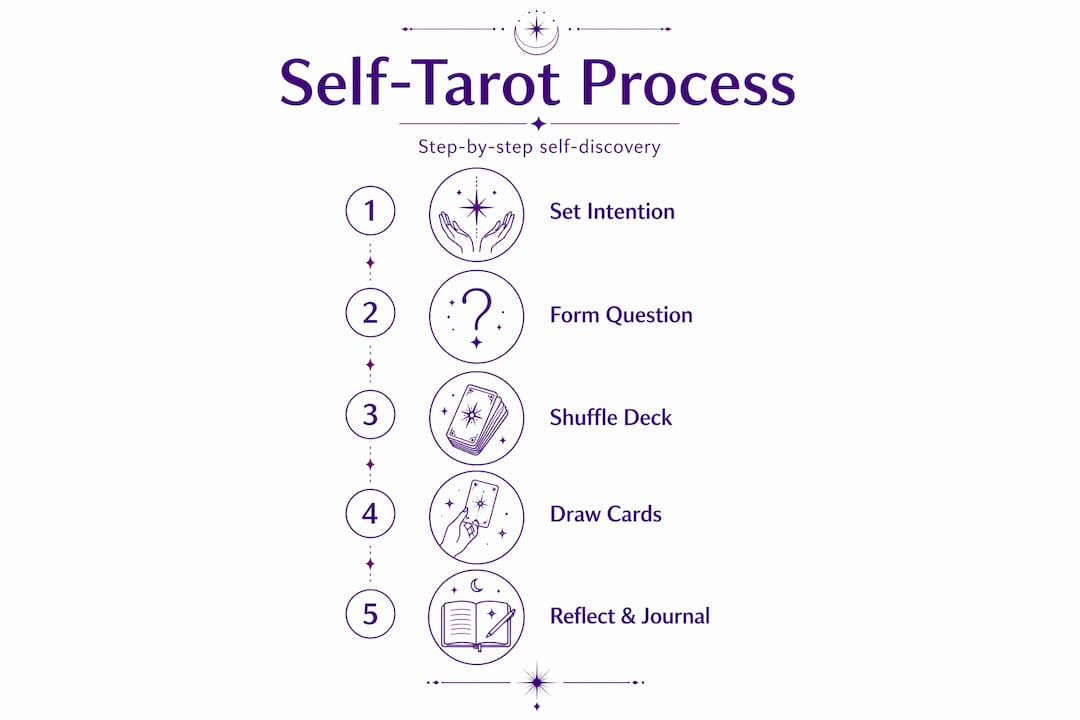
Executing your tarot reading: from shuffling to interpretation
The actual reading has four clear phases. Breaking it down this way keeps you from feeling overwhelmed, especially when you're new to this practice.
A structured self-reading moves through Preparation, The Draw, Interpretation, and Integration. Here's how each phase works in practice:
- Preparation. Hold the deck. Think about your question. Shuffle slowly and deliberately. There's no right technique. Riffle shuffle, overhand shuffle, or simply mix the cards face-down on a flat surface. Stop when it feels right.
- The draw. Pull one card for a quick daily insight. Pull three cards for a past, present, future spread. Pull five or more for deeper pattern work. Start simple.
- Interpretation. Look at the card before reading anything about it. What's your first reaction? What colors, figures, or symbols stand out? That immediate response is data. Then layer in the traditional tarot card meanings for self-discovery to add context.
- Integration. Write down what came up. Ask yourself: "Where does this show up in my life right now?" Then decide on one small action based on what you noticed.
Here's a quick comparison of the two most common approaches:
| Approach | Best for | Depth | Time needed |
|---|---|---|---|
| Single card daily draw | Quick check-ins, building intuition | Light | 5 minutes |
| Three-card spread | Exploring a specific situation | Moderate | 15 to 20 minutes |
| Five-card spread | Pattern recognition, deeper insight | Deep | 30 minutes or more |
One thing that surprises most beginners: tarot works best when it doesn't give you a direct answer. As one writer explains, tarot works by holding questions open to "help you recognize the answer you are already circling." The card doesn't tell you what to do. It shows you what you already know but haven't faced yet.
You can also explore self tarot reading examples to see how others have used specific spreads to gain clarity in love and relationships.
Pro Tip: If a card confuses you, don't rush to a guidebook. Sit with the discomfort for two minutes first. Your initial resistance often contains the most useful information.
With execution covered, it's important to understand common challenges and how to integrate your insights into your life.
Troubleshooting, common mistakes, and integrating tarot insights
Even experienced readers fall into habits that weaken their practice. Knowing what to watch for keeps your readings honest and useful.
The most common mistake is using tarot too often. If you're pulling cards multiple times a day for the same question, you're not seeking insight. You're seeking reassurance. Those are very different things. As one guide warns, grabbing the deck out of anxiety "is a signal to pause and trust yourself more." Tarot is most powerful when used with intention, not compulsion.
Other common pitfalls to avoid:
- Asking the same question repeatedly hoping for a different card
- Ignoring cards that make you uncomfortable instead of sitting with them
- Treating every card as a literal prediction rather than a reflection
- Skipping the integration phase and never acting on what you learn
- Expecting instant transformation instead of gradual, honest growth
The integration phase is where real change happens. Research on tarot and mindfulness shows that "interpretation coupled with mindfulness journaling supports positive changes in well-being and perception of control." That's a meaningful finding. It means the cards alone aren't the tool. Your reflection on them is.
Keep a simple tarot journal. After each reading, write down:
- The card or cards you pulled
- Your immediate emotional reaction
- One pattern or theme you noticed
- One concrete action you'll take this week
This practice builds self-awareness over time. You'll start to notice recurring cards, recurring themes, and recurring feelings. That's your inner life showing you what needs attention. Managing your tarot reading habits well is what turns occasional curiosity into real personal growth.
Pro Tip: Review your journal entries once a month. Patterns that weren't obvious in a single reading become very clear when you look at four weeks of entries together.
Having learned how to effectively work with tarot, the next section provides a unique perspective on what makes tarot such a transformative tool for self-discovery.
Why tarot is a vital tool for embracing uncertainty and personal agency
Here's something most tarot articles won't tell you. The real value of tarot isn't the cards. It's the discomfort.
Every meaningful decision in your life involves uncertainty. You don't know if the relationship will work out. You don't know if the career move is right. Most of us respond to that uncertainty by seeking advice, reassurance, or distraction. Tarot does something different. It asks you to sit with the question.
That's why tarot is a self-coaching tool in the truest sense. It refuses to give you a fixed answer. It forces you to sit with uncertainty "long enough to notice what your body already knows... building your capacity to create your own destiny." That capacity, the ability to tolerate not knowing and still move forward, is one of the most important skills you can develop.
This is also why tarot sometimes works faster than traditional talk therapy for certain kinds of insight. Cards can reveal unconscious beliefs and patterns, "providing breakthrough insight faster than talk therapy alone." A conversation about your feelings can stay on the surface. A card that stops you cold bypasses your defenses entirely.
The integration of psychology and tarot isn't fringe thinking anymore. It's being used in therapeutic contexts precisely because visual, symbolic prompts access parts of your inner life that words alone don't reach.
What this means for you practically: stop using tarot to get answers. Start using it to get honest with yourself. That's when tarot reading for inner peace becomes real. Not because the cards soothe you, but because you stop running from what you already know.
Explore professional tarot readings and tools for deeper self-discovery
You've learned how to read for yourself. But sometimes you need a fresh perspective, especially when you're too close to a situation to see it clearly.
Professional readings add a layer of structure and insight that's hard to achieve alone. At Astrea Tarot, you can access love tarot readings designed to help you understand your emotional patterns and relationship dynamics with clarity and compassion. If you're wondering about a specific person's feelings or intentions, the does he love me tarot readings offer focused, honest insight without vague answers. Every reading is built on the Astrea reading method, which combines intuitive card selection with structured analysis to give you guidance you can actually use. Whether you're just starting out or deepening an existing practice, these tools support your journey every step of the way.
Frequently asked questions
Is tarot reading for self-discovery the same as fortune-telling?
No, tarot reading for self-discovery is a reflective coaching tool that helps you gain personal insight, not predict the future. As Vogue explains, "Tarot cards are a tool for personal discovery and self-care," not a method for forecasting events.
How often should I do a tarot reading for self-discovery?
Use tarot when you have a meaningful question or genuinely need clarity, not out of habit or anxiety. As one guide notes, grabbing the deck out of anxiety is a signal to pause and trust yourself more.
Can tarot readings improve my mental well-being?
Yes, combining tarot with mindfulness journaling has been linked to real improvements in psychological well-being. Research shows that "interpretation of tarot cards coupled with mindfulness journaling appears to support positive changes in well-being and one's perception of control."
Do I need special skills to interpret tarot cards for self-discovery?
No special skills are required. Your best starting point is your own intuition. As Vogue notes, "the real healing work is done by the person," not the cards themselves.
What's the best type of question to ask in a self-tarot reading?
Open-ended, agency-focused questions work best. Questions like "What do I need to understand right now?" invite real reflection. Closed yes/no questions limit the insight you can draw from a reading.